
 EN



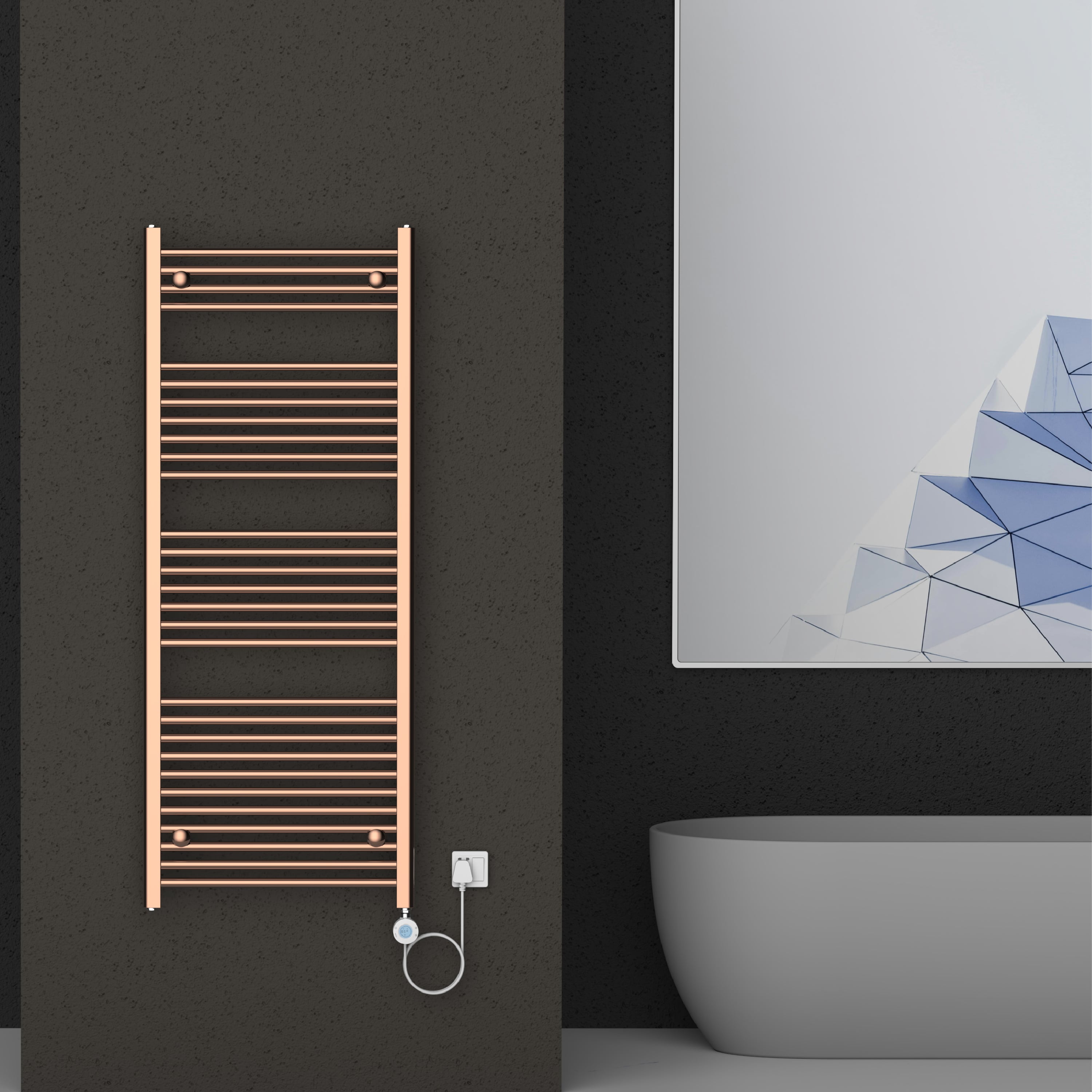
Specifying a towel warmer for a residential project or retail range? The heating method you choose determines everything—heat-up time, running costs, installation complexity, and after-sales risk. Get it wrong, and you’re either dealing with customer complaints or leaving margin on the table.
We broke down the three heating technologies that dominate the European and North American markets, with real-world data and installer feedback from Reddit forums to help you match the right method to the right application.
How Each Heating Method Works
Heated Element With Liquid (Liquid-Filled)
A liquid-filled towel rail is pre-filled with a water and inhibitor solution. An electric immersion element heats the liquid, which circulates through the bars via convection currents, warming the entire rail evenly.
This method reaches around 55°C regardless of whether a towel is covering the bars, and it acts as a supplemental heat source for the bathroom. Heat-up time is longer—roughly 60 minutes to reach optimum temperature—but the thermal mass keeps the rail warm long after the element switches off.
Electric Resistance Heating (Dry Element)
A dry electric towel rail uses a resistive heating cable running through the bars. The cable heats the air inside the bars directly, and when you place a towel over the rail, the fabric insulates the surface, raising the temperature beneath the towel to 50–55°C.
The key advantage: speed. Dry elements warm up in about 5 minutes and reach optimum temperature in roughly 30 minutes. The trade-off is that a dry element towel rail is not designed to warm the room—heat is concentrated under the towel.
Hydronic Heating
A hydronic towel radiator connects directly to your central heating system. Hot water from the boiler flows through the rail, heating both the towels and the bathroom space.
Because it runs on the same hot water that feeds your radiators, running costs are minimal if the boiler is already operating. The downside: if the central heating is switched off for summer, the towel rail is inactive unless you install a dual-fuel system with a backup electric element.
Key Differences at a Glance
| Factor | Liquid-Filled | Electric Resistance | Hydronic |
|---|---|---|---|
| Heat-up time | ~60 minutes | 5–30 minutes | 30–60 minutes |
| Surface temp | 55°C constant | 35°C bare / 55°C under towel | 55°C |
| Room heating | Supplemental | No | Yes |
| Running cost | Moderate | Higher (electricity) | Minimal (boiler already on) |
| Installation | Plug-in or hardwired | Plug-in or hardwired | Plumber required |
| Summer use | Yes | Yes | No (unless dual-fuel) |
What Reddit Users and Installers Say
On r/Plumbing and r/DIYUK, the debate between electric and hydronic comes down to one question: how do you plan to use it?
Reddit user u/ConvectionCurrent noted: “Hydronic is great if your heating is already running. But in summer, you’re stuck with damp towels unless you go dual-fuel.”
Another installer on r/Plumbing shared: “For rentals and apartments without boiler access, dry electric is the only practical choice. Plug it in, done. No pipework, no drain-down.”
On liquid-filled models, users consistently mention the even heat distribution. One homeowner wrote: “My liquid-filled rail heats the whole bathroom, not just the towels. Takes longer to warm up, but the residual heat is worth it.”
A common complaint with dry electric rails: “The bars get hot, but the towel doesn’t warm evenly. You have to fold it carefully.” This is where liquid-filled and hydronic models have an edge—the entire surface heats uniformly.
Matching the Method to Your Project
New Builds and Renovations
For projects with plumbing access, hydronic is the most energy-efficient choice. It integrates seamlessly with boiler systems and TRVs, and running costs are negligible when the heating is on. Pair it with a boiler magnetic filter to protect the heat exchanger from sludge—especially important in systems that already have several radiators.
Avonflow’s FR03 hydronic series is designed for central heating integration, with international-standard mild steel construction, IPX4 rating, and CE/GS/NF/Keymark certification. Surface temperature runs at 55°C ± 3°C.
Rental Properties and Apartments
Electric resistance models are the practical choice for rentals and apartments without boiler access. Plug-in installation requires no plumber, and the tenant can take it when they move.
For distributors, this segment offers volume potential. But watch the return rate—cheap dry elements often disappoint on heat output. Specify models with adequate wattage and a timer to manage running costs.
Avonflow’s electric range includes models from 891 BTUs (700×450mm) to 2,777 BTUs (1800×500mm), with IPX4 rating and powder-coated or chrome finishes.
Premium Residential and Hospitality
Liquid-filled models hit the sweet spot for hotels and high-end residential projects: even heat, supplemental room warmth, and year-round operation. They take longer to heat up, but once warm, they stay warm. The higher upfront cost is offset by reliability and guest satisfaction.
For specifiers, the key metric is surface temperature consistency. A liquid-filled rail maintains 55°C even when covered with towels. A dry element drops to 35°C when bare.
Running Costs and Energy Efficiency
Hydronic towel radiators use less energy than electric systems because they rely on the boiler’s existing hot water rather than generating heat from electricity. In regions where natural gas is available, the annual running cost of a hydronic system comes in well below electric alternatives.
Electric models consume 50–150 watts—far less than a hair dryer—but electricity is more expensive per kWh than gas. Annual running costs for electric towel rails typically range from $25 to $75, depending on usage and local tariffs.
For EU markets, the EcoDesign regulation (EU) 2024/1103 introduces new requirements for towel rails with output above 60W and up to 250W. These must be complemented with controls providing scheduling and temperature regulation functions. Distributors and OEM buyers should verify compliance before importing.
FAQ
Which heating method is cheapest to run?
Hydronic, if your boiler is already heating water. Electric resistance is more expensive per hour but may be the only option without plumbing access.
Can I use a hydronic towel rail in summer?
Only if it has a dual-fuel option with a backup electric element. Otherwise, it stays cold when the central heating is off.
Do liquid-filled towel rails need maintenance?
No. They arrive pre-filled and sealed. The liquid never needs topping up or replacing.
Which method heats the bathroom best?
Hydronic and liquid-filled models provide supplemental room warmth. Dry electric models are designed for towel warming only.
Are electric towel rails energy-efficient?
They are 100% efficient at the point of use, but electricity costs more than gas. Use a timer to control running costs.
What certifications should I look for?
CE, Keymark, and NF for European markets. Avonflow’s range carries these certifications across all three heating methods.